The Upstream Principle
Walker Briefing

The Available Remedies, Part One
A note on what follows
Yesterday I examined how the condition this Briefing has been diagnosing appears at the centre of the international system. A war launched during active negotiations, justified in contradictory ways by the same administration within a single week, prosecuted without allied consultation, concluded by a ceasefire brokered by a third country that the belligerent party had not thought to involve in its planning. The piece argued that no functioning deliberative process could have produced this outcome, and that the condition the Zhōng Yōng series has been naming for months is now visible at the highest level of international decision-making. That article stands on its own. I will not rehearse its argument here, except to note that it belongs to the diagnostic work of the original series. What follows belongs to something different.
This is the first piece in a new series. It has a name, The Available Remedies, and it has a purpose that must be stated clearly before it begins, because the legitimacy of everything that follows depends on being honest about what this series is and what it is not.
The method, and what the series will not do
The diagnostic series examined a condition. This series examines what can be done about it. The transition from diagnosis to remedy is the most dangerous moment in any inquiry of this kind, because it is the moment when analytical discipline is most likely to give way to advocacy. A thinker who has identified a structural problem is under enormous pressure, psychological and social, to announce the solution. The pressure comes from readers who want to know what to do, from the political environment that rewards decisive proposals, and from the thinker’s own desire to be useful rather than merely observant. Almost every public inquiry of this kind has failed at this transition. The diagnosis has been disciplined and the prescription has been ideological.
This series will attempt not to make that mistake. It will do so by observing a small number of rules, which I want to set out now so that readers can hold me to them.
The first rule is that remedies are examined, not prescribed. The difference is not cosmetic. An examined remedy is one whose evidentiary basis is presented honestly, whose limitations and risks are acknowledged, and whose transferability to Australian conditions is tested rather than assumed. A prescribed remedy is one that the writer has decided to support, presented in the language of options. The test for the distinction is whether the writer could, on the evidence presented, have reached a different conclusion. If not, the piece is advocacy.
Next is that the remedies examined in this series will not be pre-selected to fit a political programme. I am conscious, as the writer, of the political positions I hold, and I am conscious that those positions will shape what I notice and what I find persuasive. The discipline is not to pretend those positions do not exist. It is to allow the evidence to complicate them where the evidence genuinely complicates them, and to say so when it does. Readers will be able to judge whether this discipline is being observed, because a series that honestly examines remedies will occasionally arrive at conclusions that do not fit the writer’s prior preferences. If that never happens, the series has failed its own standard.
Following this comes the third rule that each remedy will be assessed against a consistent set of questions. What is the evidence that this remedy addresses the condition the diagnostic series identified, rather than some other condition? Where has it been tried? What did it achieve there, and at what cost? What were its unintended consequences, and how serious were they? What conditions in the original jurisdiction enabled it to work, and are those conditions present in Australia? What obstacles to adoption exist in Australia specifically, and are they obstacles of constitutional structure, political incentive, or public culture? Each of these questions must be answered, or its absence acknowledged, before a remedy can be said to have been examined.
Fourthly is that the examination proceeds under the same philosophical discipline that governed the diagnostic series. The Zhōng Yōng tradition holds that proportionate judgement requires calibration to conditions rather than to pressures. That applies as forcefully to the examination of remedies as it did to the examination of failure. A remedy pursued with disproportionate enthusiasm, adopted because it fits a preferred political identity rather than because it addresses the condition, reproduces the very pattern of misjudgement the remedy was meant to correct. The cure, in other words, is subject to the same tests as the disease.
And finally the rule is that the examination belongs to the reader, not to the writer. I will set out what I have found. I will try to set it out clearly and without manipulation. The decision about what any of it means, and what should be done, does not belong to me. It belongs to Australians, and it belongs to them collectively through whatever mechanisms of deliberation their system permits. The question of what those mechanisms are, and whether they are adequate, will itself become part of what the series examines.
These rules are not a disclaimer. They are a contract with the reader, and I expect to be held to them.
Why upstream
The first remedy in any examination of structural recovery is not actually a remedy at all. It is a principle that governs how remedies are chosen. The principle has various names in different fields. In medicine it is called prevention. In systems theory it is called root cause analysis. In the work of the Australian writer John Macgregor, whose book The Mechanics of Changing the World I will be engaging with at various points in this series, it is called the upstream principle. The name I will use is Macgregor’s, because his formulation is the sharpest and because it is the one I have found most useful in thinking about Australian conditions.
The upstream principle is not original to Macgregor, and he would not claim it was. The concept exists in various forms across medicine, systems theory, engineering, and public health. What Macgregor has done is to apply it with unusual rigour to the question of democratic design, and to show how its absence from conventional political analysis is itself a diagnostic feature of the condition he and I are both attempting to describe. His formulation is embedded in a larger argument about structural reform that readers who want to test my characterisation can engage with directly. Macgregor writes at johnmacgregor.substack.com, and I would encourage readers who find the upstream principle useful to read him in his own words rather than relying solely on my account of his work.
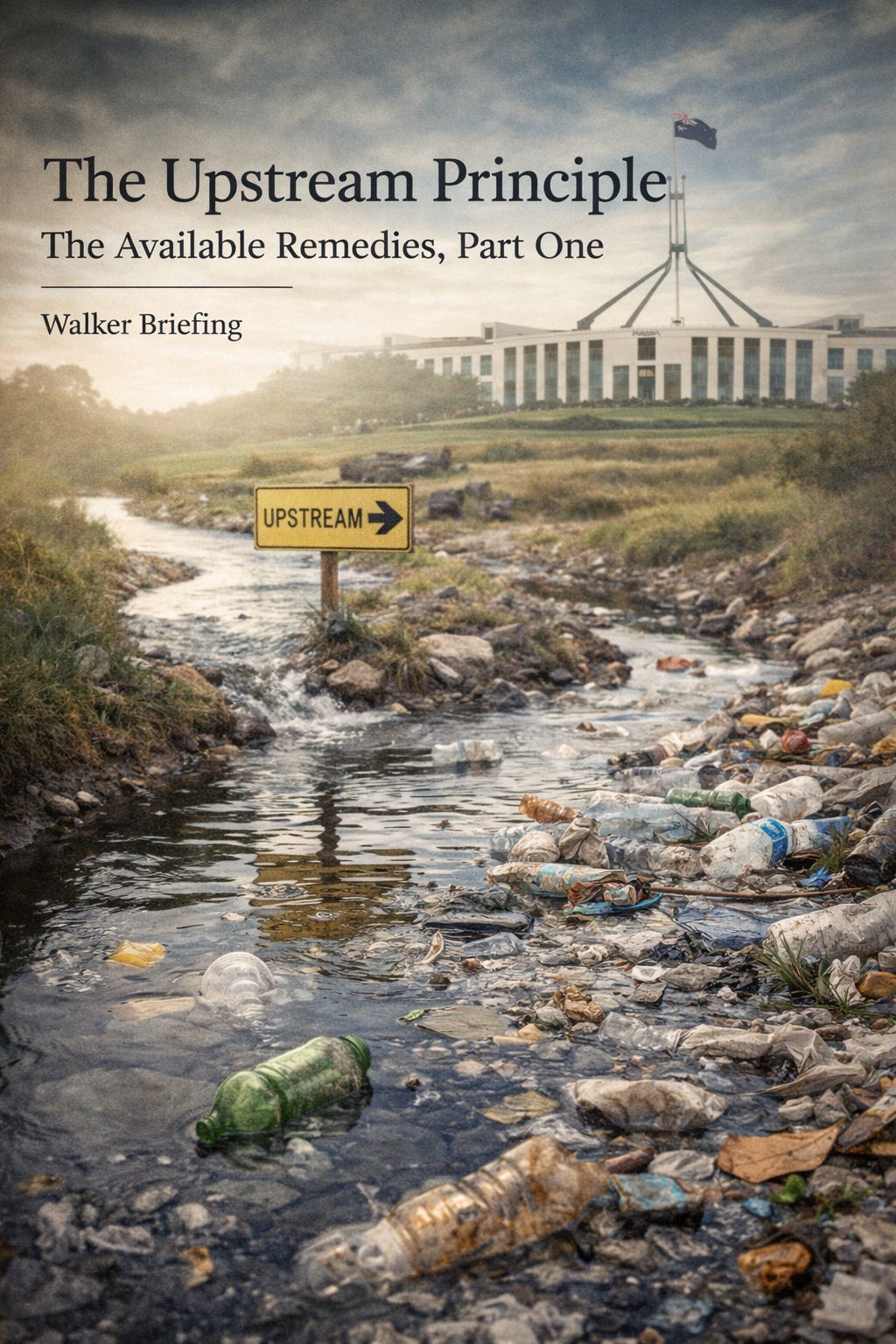
The upstream principle holds that a problem is best addressed as high as possible in its causal chain. If a stream is carrying pollution into a lake, you do not solve the problem by cleaning the lake. You walk upstream until you find the source of the pollution and you stop it there. The lake will clean itself. If you clean the lake without stopping the source, you will spend forever cleaning the lake, and the lake will get dirtier every year despite your efforts, and eventually you will conclude that lakes are simply dirty and the best you can do is manage the dirt.
The metaphor is simple but the principle it describes is not. Almost every political system in the democratic world is currently engaged in the cleaning of lakes. Enormous resources are devoted to managing the downstream consequences of decisions that were made upstream. The language of politics reflects this. We speak of crisis management, of response capacity, of service delivery, of intervention points. All of these concepts assume that the problem is something that has already happened, and that the task of government is to mitigate its effects. The possibility that the problem could have been prevented at an earlier stage, by a decision made somewhere further up the causal chain, is rarely part of the conversation. When it is raised, it is dismissed as naïve or utopian or politically impossible.
Macgregor has a phrase for what this produces. He describes contemporary democracy as “the architecture of repair, a trillion-dollar infrastructure to mend what was preventable: collapsed banks, oil spills, terrorism, poverty, and free-wheeling pandemics.” The phrase is accurate, and the architecture it names is the one we have built in Australia as thoroughly as any other Western democracy. What follows is what that architecture looks like in practice, and what the upstream alternative would require.
One further observation is necessary before the application begins, because it connects this series to the diagnostic work that preceded it. The article published yesterday examined the loss of proportionate judgement at the level of international decision-making, using the Iran war as its primary case. A reader might reasonably ask why the next piece turns from strategic collapse at the centre of the international system to domestic questions of health and housing in Australia. The answer is that these are not separate questions. A country that cannot act upstream in its own domestic systems will not be capable of acting upstream in its defence posture, its alliance management, or its strategic planning. The capacity for proportionate long-term decision-making is not domain-specific. It is a quality of the deliberative process itself, and a system that has lost it in one domain will exhibit the same loss in every other. Australia’s strategic resilience, its ability to maintain coherent policy across electoral cycles, its capacity to plan for circumstances that have not yet arrived, all of these depend on the same structural conditions that determine whether the health system can prevent disease or the housing system can shelter its workforce. The upstream principle is not an argument about social policy as distinct from strategic policy. It is an argument about the prior conditions of national capacity, and the strategic questions that confronted this country last month cannot be addressed without attention to the domestic conditions examined in this one.
The clinical case, and why it matters
I am a general practitioner. I have spent my working life, when I have not been in parliament, in consulting rooms with patients whose conditions were mostly preventable. Type two diabetes, heart disease, chronic kidney disease, stroke, chronic obstructive pulmonary disease: these are the conditions that fill Australian hospitals and consume the largest share of the health budget. A general practitioner working in Western Australia sees this pattern with particular clarity, because the distance between a preventable condition and the nearest specialist intervention is measured in hundreds of kilometres as well as in dollars, and because a state whose economy depends on a mobile skilled workforce pays a visible price when that workforce is unwell. Each of these conditions has a downstream presentation that is enormously expensive to treat and an upstream causation that is considerably cheaper to address. The evidence for this is not contested in the medical literature. It is contested, if at all, only in the political system that decides how health budgets are allocated.
In 2023 to 2024, Australia spent $270.5 billion on health (figures from the Australian Institute of Health and Welfare’s Health Expenditure Australia 2023-24 report). Of that, the proportion of government health spending directed to public health activities, the category that includes prevention, was 2.9 per cent. The National Preventive Health Strategy, published in 2021, set a target of 5 per cent of total health spending on prevention by 2030. We are not halfway there. The share actually fell between 2022-23 and 2023-24, as the post-pandemic public health budgets were wound back.
Consider what these numbers describe. A country spends more than a quarter of a trillion dollars a year treating conditions, a substantial proportion of which could be prevented or delayed by measures costing a small fraction of the treatment bill. The prevention measures are known. The evidence for them is strong. The cost-benefit calculation favours them overwhelmingly. And yet the share of the health budget directed to prevention remains at a level that almost guarantees the treatment budget will continue to grow faster than the country can afford.
This is not a failure of medical knowledge. The medical profession has known for decades which interventions prevent which diseases and at what cost. It is not a failure of public awareness. Australians broadly understand that diet, exercise, smoking, alcohol, and chronic stress are the drivers of the conditions that are killing them. It is not a failure of policy innovation. Other OECD countries have implemented preventive health programmes with measurable results, and their methods are available for study.
It is a failure of the deliberative process. The health system is structured so that treatment generates visible outputs (procedures performed, beds filled, patients discharged) while prevention generates invisible outputs (diseases that did not occur, admissions that did not happen, money that did not need to be spent). Visible outputs attract political credit and budget allocation. Invisible outputs do not. Over time, the system allocates resources to the activities that produce visible outputs, and the invisible outputs decline. The consequence is a health system that is, as I have written previously, efficient at the wrong things.
The upstream alternative is not complicated in its description. It would involve the systematic reallocation of health resources from treatment to prevention, the introduction of structural measures that make healthier choices easier (food labelling, advertising restrictions on unhealthy products, urban design that encourages physical activity, alcohol and tobacco pricing calibrated to discourage consumption), and the long-term commitment to maintain these measures across electoral cycles so that their effects can accumulate. The obstacles to this alternative are also not complicated in their description. They are the food industry, the alcohol industry, the advertising industry, the urban planning profession, the political donation structures that connect these industries to both major parties, and the news cycle that cannot tolerate reforms whose benefits arrive on timescales longer than the next election. None of these obstacles is a law of nature. Each of them is a structural condition that could, in principle, be changed. Whether it can be changed in practice in Australia is a question the rest of this series will examine.
The housing case, and why it matters more
If the health system demonstrates the upstream principle at the individual level, the housing system demonstrates it at the level of a generation.
The cost of a Western Australian home is, by any historical standard, extraordinary. A generation ago, the median house price in a major Australian city represented roughly three to four times the median household income. Today, in many parts of the country, the ratio is closer to ten to one. A young person starting their working life in 2026 confronts a housing market in which the prospect of ownership is, for the first time in the country’s postwar history, not realistically available to the majority of their cohort. This is not a cyclical problem. It has persisted across two decades of both major parties holding power, under different economic conditions, with different levels of immigration, through booms and recessions. It is a structural condition.
The downstream responses to this condition are familiar. First home owner grants, stamp duty concessions, shared equity schemes, deposit guarantees, social housing subsidies, rent assistance, increases to the pension. Each of these measures is directed at the symptom. Each of them is cheaper to announce than to fund adequately. Each of them is marketed as a solution. And each of them has produced almost no measurable change in the underlying affordability trajectory. The downstream architecture of repair is working precisely as Macgregor’s framework predicts: it absorbs enormous resources, it generates political theatre, and it does not address the condition it purports to treat.
Upstream of all these measures lies a set of decisions that were made over a period of roughly forty years, mostly quietly, mostly by both major parties, and mostly without public deliberation. The treatment of housing as an investment asset rather than as shelter. The capital gains tax discount, introduced by the Howard government in 1999. Negative gearing, briefly abolished by the Hawke government in 1985 and reinstated in 1987 under political pressure from property investors. The reliance on immigration to sustain population growth faster than the housing stock can expand. The restriction of urban density in areas where demand is highest. The structural subordination of affordability to the protection of existing asset values, because existing asset values represent the wealth of the generation that votes most reliably. These decisions produced the condition. They were upstream, they were structural, and they were the product of a deliberative process that was functioning exactly as its participants intended.
It is worth noting that this analysis is not a partisan position. The housing settings examined here have been defended by both major parties across decades. Labor reinstated negative gearing in 1987. The Coalition introduced the capital gains discount in 1999. Both parties have governed during the period in which the price-to-income ratio has tripled, and neither has used its time in office to reverse the underlying settings. The critique offered here is not directed at one side of Australian politics. It is directed at a structural arrangement that both sides have sustained.
This is the point that matters. The housing crisis is not the result of deliberative failure in the sense that the Iran war was the result of deliberative failure. The Iran war was produced by a process that had collapsed. The housing crisis was produced by a process that was working correctly, for the people who designed it, at the expense of the people it was going to affect later. This is a more difficult kind of failure to address, because it cannot be corrected by restoring deliberation. The deliberation produced the outcome. The deliberation itself has to be restructured so that the people who will bear the consequences of a decision have standing in the decision.
How that restructuring might be attempted is the subject of the next several articles in this series. For this piece, the point is simpler. Both the health case and the housing case illustrate the same principle. Downstream responses to structural problems absorb enormous resources without addressing the problem. Upstream responses are cheaper, more durable, and harder to implement, because the structural conditions that produced the problem are also the conditions that protect it from correction. Any serious examination of available remedies has to begin upstream, because the alternative is to spend the next generation cleaning the lake.
What this commits the series to
The upstream principle is not itself a remedy. It is the criterion by which remedies will be assessed in the articles that follow. A proposal that operates downstream, that addresses the symptoms of a condition rather than its causes, will be treated with scepticism not because downstream responses are wrong, but because a system dominated by downstream responses is, by definition, a system that has given up on addressing the causes. The reader can hold the series to this criterion as it unfolds. If a proposed remedy later in the series turns out to be a downstream patch dressed in upstream language, that will be evidence that the discipline has failed, and the reader should say so.
The second commitment is that the series will not confine its attention to remedies that are currently politically fashionable. Some of the remedies examined in the coming articles will be uncomfortable for progressive readers. Others will be uncomfortable for conservative readers. That is not because I have set out to balance the discomfort. It is because the upstream principle has no political alignment. It is a structural test, and structural tests are indifferent to the preferences of the people applying them.
The next consultation
The original Zhōng Yōng series ended with the image of a patient in a consulting room, confronting a diagnosis and the question of what to do about it. The transitional piece published earlier this month returned to that image and noted that the next phase of the relationship between practitioner and patient, in any competent clinical practice, is the consultation about what can be done. That consultation has now begun.
What it has not yet produced is any specific proposal. The piece you have just read has said only that remedies will be examined upstream rather than down, and that the examination will follow a set of disciplines that the reader can observe and, if necessary, object to. That is a small thing to have established in nearly three thousand words. It is also the essential thing, because without it nothing that follows in this series can be trusted as analysis rather than advocacy.
The next article will examine the first substantive remedy: the use of citizen assemblies and other forms of deliberative democracy to make decisions that the conventional political process has shown itself incapable of making well. The evidence for this approach is more substantial than most Australians realise, and it is more contested than most of its advocates will admit. Both the substance and the contestation will be examined honestly. The patient will be asked to consider it, and the decision about whether it represents a genuine option or a distraction will belong to the patient, as it must.
This article is part of The Available Remedies, a new series on the Walker Briefing examining structural responses to the conditions diagnosed in the preceding Zhōng Yōng series. The full archive is available at bfwalker.substack.com.