
The Question of Will
Walker Briefing

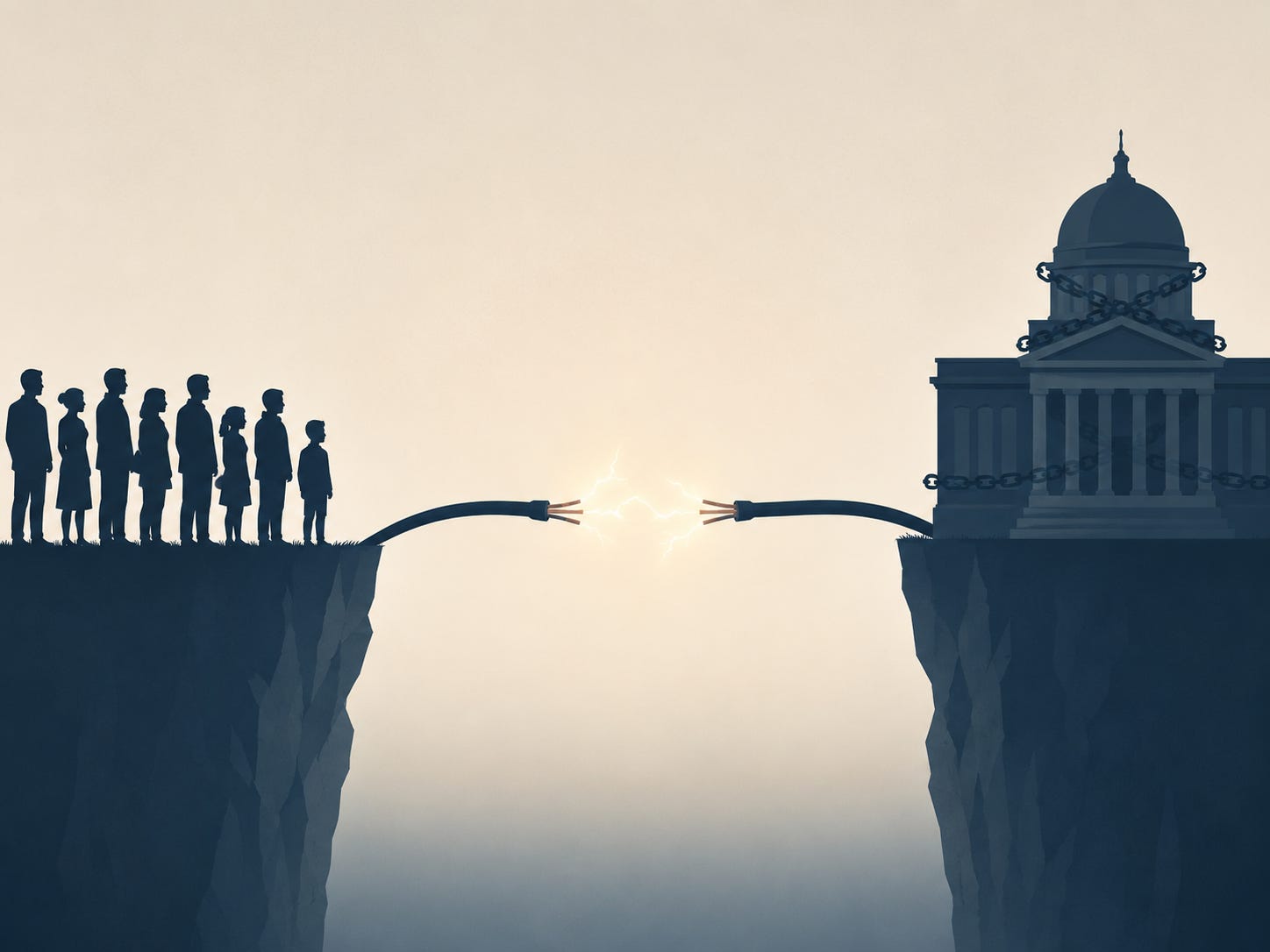
The last piece left a question hanging, the way the one before it left a question for that. If some of what divides us is real and some of it is only made to look that way, and a person can now tell which is which, then we are no longer asking whether we secretly agree. We are asking something harder. What can a public that sees a little more clearly actually do about the things that are genuinely wrong?
The answer I hear most often comes in three words. Lack of political will. Yes, OK, four words. The evidence is in, the money could be found, the better way is known, and still nothing moves, because the will is not there. People say it with a sigh, as though it settled the matter.
It settles nothing, at least not the way it is usually said. Watch how the phrase tends to work. Something needed doing and did not get done, and we say the reason is there was no will to do it. But the only evidence we have that the will was missing is that the thing did not happen. The claim and the proof are one fact wearing two coats. Nothing happened, so there was no will, and how do we know there was no will? Because look, nothing happened. You can walk around that circle all day and never once touch the ground.
I want to take the phrase apart and see what is inside it. I should not overstate the charge, though. The words are not always empty. People who study this for a living broke “political will” open long ago into things you can actually look for, and used that way it earns its keep. What I am going after is the lazy use, the one that turns up after the event to explain a failure and explains nothing. And I have to watch myself for a second reason, because pulling a phrase apart is easy and the tempting next move is to swap in one of my own that is just as empty and suits me better. So here is a test, and I want you to hold me to it at the end. If there is such a thing as the will to act, it has to be made of parts you could go and look for in a real case. Was there someone with the power to decide who actually committed to the thing, out loud, rather than merely nodding at it? Was there a worked-out answer ready to go, or only a good intention? Was there real money behind it, or just the announcement of money? Was it somebody’s job to carry it, or nobody’s? And were the people who wanted it numerous and firm enough that they could not simply be picked off one at a time? Those you can check, case by case. “Was the will there” you cannot. Break the word into those parts and it stops being a place to give up and becomes a handful of questions that have answers.
I could gather those parts into a neat numbered list and give it a name. I have done that twice already, with the kinds of waiting and the kinds of division, and a third would start to feel like a conjuring trick rather than a tool. So I have named the parts and left them loose on purpose. The point is not another framework to admire. It is the one question sitting under all of them, and I would rather you kept your eye on that than on my furniture.
Two answers I am not going to give you
Reach past the empty phrase and most people land on one of two answers. Both are too tidy to be true.
The first says the public does not really want it. Underneath the talk people are comfortable, or selfish, or too distracted to care, and the stillness just shows it. That answer holds the public in quiet contempt, and I do not believe it, for reasons I will build toward. The second is its mirror. The public wants the thing badly and someone powerful is standing on the hose, and if you could shift the boot the water would run. That one flatters everybody but the villain, and it is the answer I have to watch hardest, because it happens to suit me.
I sit on the crossbench and I lead a small party. If the real story turned out to be a willing people held down by a rigged system, that would be a very convenient story for me to be caught telling. It suits my politics. It suits this writing and the readership I am trying to build for it. It suits the election I have told you I am working towards. So I am not going to confess the bias and sail past it, because a confession you sail past is just a way of buying a permit. I am going to show you, as we go, the places where the convenient answer could have won and did not, and the place near the end where the evidence turned against me and I had to go with it. If by the finish it looks like I simply arrived where I always meant to, then I have failed my own test, and you should tell me so.
What actually moves a country
Here is what I have come to think converts a willing public into an acting one. It is not comfortable, and it turns out not to be the whole story either.
People do not change course because someone showed them the better argument. I learned that as a doctor long before I learned it in politics. You can tell a patient the plain truth about their own body, clearly and kindly and in full, and watch it slide off them, and then one ordinary Tuesday something happens that they cannot argue away, and every word you said arrives at once and too late. Change comes on contact with a consequence you can no longer defer. The argument only lays the ground. The consequence is what breaks it open.
Countries look the same at first, only slower to admit it. Take the two clearest cases we have. In 1996, thirty-five people were shot dead at Port Arthur, and within weeks the country had gun laws that a fractured, gun-friendly politics had failed to produce across all the quiet years before. In December 2025 fifteen people were killed at a Hanukkah gathering at Bondi Beach, and within days a national cabinet had met and inside a fortnight the New South Wales parliament had passed what its own government called the toughest gun laws in the country. Both times the country moved at a speed that would have looked impossible the week before, and both times it was not a new fact about guns that moved it. The facts had been lying around for years. It was a consequence too big and too raw to be argued with.
Now look harder, because the two cases are not the same, and the difference is the whole point. Port Arthur did not invent Australia’s gun laws on the day, and I can show that without leaning on the fact that reform followed. The direction had been argued for years. Earlier shootings had already produced inquiries and calls for uniform national controls, and the answer was largely drawn up and waiting: the proposals Howard reached for came from a national report written years before. There was real prior appetite for reform. I will not pretend the whole country was already agreed, because the overwhelming public backing, better than nine in ten, gathered in the days after the massacre rather than before it. What the shock supplied was not the answer, which already existed, but the agreement and the political permission to use it, and what Howard did was spend his own side’s goodwill to carry it against his base, which is the part that took nerve. The massacre did not draw up the answer. It forced open a door that patient work had already built. Bondi is the less tidy case, and I will not tidy it. Some of what New South Wales passed had been sitting ready, the long-promised national firearms register chief among it, but a good deal of the package was written fast, in the days after the killing. So Bondi shows something slightly different from Port Arthur. It shows that when the shock is large enough and the will converges hard enough, a system can assemble an answer at speed. It is the weaker case for my point, and it is more honest to say so than to pretend the two are the same clean shape.
Take them together, though, and the lesson holds, and it is not the one it first looked like. The reliable thing is not the catastrophe. We have had, for more than a decade, exactly that kind of undeniable consequence arriving on climate, again and again. Fires that took whole towns. Floods that came back to the same streets before the carpets had dried. Summers nobody can remember the like of. By the logic of Port Arthur that run of disaster should have moved the country the way the shootings did. It has not, and the appetite for acting on it has if anything softened rather than hardened, as I will come to. So the neat rule, that catastrophe converts, breaks on the clearest test we could put to it. What Port Arthur really shows, once you see Bondi beside it, is that the shock only ever fires what somebody has already loaded. Where a worked-out answer was ready and the public was of a mind to be moved, as at Port Arthur, the shock converts, and fast. Where there is no agreed answer and the division underneath is real, as on climate, the same shock lands and burns itself out in argument while the country grieves and stays put. The catastrophe is a trigger, never the cause. The cause is the slow, unglamorous, unpaid work of preparing an answer and building an agreement in the years beforehand, while nobody is watching and nothing is burning. Hold onto that. It is the one lever in all of this that human hands can actually reach. We do not get to schedule the disaster. The preparation is entirely ours to do or to neglect.
Why simply agreeing is never enough
Even where the agreement is real and wide, it does not turn itself into action, and the reason is plain. It is the same reason I gave a few pieces back for why a good idea sits on the shelf when nobody is paid to lift it.
Picture something that would help almost everyone a little and cost one particular group a great deal, with the help arriving years from now and the cost landing today. Everyone is mildly for it. Nobody is desperately for it. The group that pays is small and frightened and turns up every single day. The crowd that benefits is enormous and scattered, and each person in it waits, quite reasonably, for somebody else to do the pushing, because one pair of hands changes nothing and the reward arrives either way. So the small group is always in the room and the big one almost never is, and the thing most people want does not happen. No plot is needed for that. A wide shallow wish loses to a narrow deep one nearly every time, unless something gathers the shallow wish into a shape that can act, and the gathering is a job that usually belongs to no one.
Set that beside the last point and the parts of the thing we call will start to show, the same parts I set out at the start. Someone with the power to decide who actually commits. A worked-out answer, ready to go. Real money behind it. Somebody whose job it is to carry it. And a body of support broad and firm enough to hold when a narrow, deep interest leans the other way. Those are not moods. They are arrangements, and you can walk up to any stalled good idea and check them off one at a time.
What people actually want, which is not what I want
Before I tell you the mood of the country, there is something that cuts against the case I would rather make, and if I skip it you have no reason to trust the rest.
When I say the wanting is still there, look at what is actually wanted. It is not one thing, and it is not all mine. One of the fastest-growing feelings in our politics does not run towards what I would call progress. It runs the other way, towards tighter borders and a smaller, less meddling government, and it is not a tantrum and it is not stupidity. It is coherent, it is deeply held, and the people who hold it can give you their reasons. I said a piece ago that some of what divides us is real and lasting disagreement about how to live, and not a trick of the light, and I meant it. This is some of that. Real division, and real will, pointed somewhere I am not.
So I am not going to stand here and tell you there is a stifled majority all quietly wanting what I want, pinned down by a wicked few. That is the flattering answer with a rosette on, and it does not survive its own evidence. My claim is narrower, and I think it is both truer and, oddly, more hopeful. People who want opposite things share one thing, whatever their politics. They have each watched the machine in the middle fail to deliver the thing they wanted, whatever it was.
I have to be careful with that word, machine, and with the word wiring I am about to lean on, because they can be made to explain too much, and a thing that explains everything explains nothing. So let me say plainly what a broken means is not. It is not a broken means when a proposal is put fairly to the public and loses. It is not a broken means when a government with only so much money and time chooses one worthy thing over another. It is not a broken means when a cause loses a straight democratic contest, because being outvoted is not the same as being unheard. And it is not a broken means when a country cannot give two groups what they want because what they want is opposite. A democracy is bound to disappoint somebody whenever people want contrary things, and that disappointment is the system working, not failing. The woman who wants faster action on emissions and the man who wants the boats turned back both feel let down, and they cannot both be right that they were let down in the way I mean, because the system cannot hand each of them a win. What I am pointing at is narrower and more particular than general disappointment. It is the case where the wanting is there and settled, and a workable answer exists, and still nothing reaches the ground, not because the public weighed it and chose otherwise, but because there was no working path from what they wanted to what got done.
What it looks like now
None of this is guesswork, because it has been measured, and the measurements do not match either easy answer.
Ask Australians whether government should be doing something about the things pressing on them, and across every one of the thirteen areas a recent national survey put to them, most said yes. Ask whether they believe government can actually deliver it, and the faith is falling away. Ask whether they will pay the tax or carry the debt the doing would cost, and they say no to both. Want it done, doubt it can be done, refuse to fund the doing. Some of that is just the old gap between what any of us wants and what we will pay for, and it is nothing new. But it is sharper now than it has been, and the shape underneath it is the one I keep coming back to. Not a people who have stopped caring. A people let down often enough that they have stopped betting on the thing that keeps letting them down, while still, underneath, wanting what it was meant to give them.
You can see the same retreat in the way people are backing out of the whole apparatus. Trust in government is low, only a little up from the depths it reached through the 2010s. The share who say they would still bother to vote if the law did not make them has dropped to the lowest ever recorded. For the first time on record, more people feel close to no party at all than feel close to the main conservative party, and for the first time more Australians gave their first vote to a minor party or an independent than to the main opposition. That is not a country falling out of love with democracy. Most still say they would pick it over anything else on the table. It is a country falling out of faith with the particular machinery in front of it, feeling along the wall for another door.
And here is the part that costs me. If the will were simply there and only blocked, you would expect it to burn steadiest where it once burned hottest. On climate it has not. The concern that held firm through years of hardship has softened as the cost of living has bitten, with fewer people now willing to bear real costs to act and more saying the current effort is about right. I do not think that makes the earlier concern a fake. Frightened people pull their gaze inwards to the bill on the table, and that is not a moral failure, it is what fear does. But I cannot use it to save my case, and I will not. It means I cannot tell you the will is simply a fixed store of the right kind that the system is sitting on, because under enough strain some of it genuinely thins, and some of what thins is exactly the will I most wanted to find intact. A man with a working theory has to say where the evidence pushes back on him, and here it pushes back hard, on the ground I care about most.
One case close to home shows the other side, where the wanting and the means did meet and did hold. When this state closed its borders through the worst of the pandemic, the pressure to reopen came hard, and it came from above, the national government of the day among the loudest. The state held. It held because the public here backed it and kept backing it, right through a legal challenge that went to the High Court and lost.
There is a coda worth telling, because it is rare. The man who, as prime minister, backed that legal challenge, Scott Morrison, has since taken the mistake on himself. In an interview for a coming book he said the West Australian border made a lot of sense, and called his own opposition to it a massive mistake and, more than once, a disaster. To be fair to him, some of the regret is plainly political, counted in the seats his side lost here, and he lays the first decision partly on the advice of others. But there it is, from the man who fought them: they were right and he was wrong. I will rest the point on that and no more. I am not claiming the border was, on every measure, the best call available, and a person could argue the costs of it in good faith. I am claiming the narrower thing my argument actually needs. A settled public wish. A government with the power to act on it and close enough to be moved by it. Strong enough to hold against a larger power leaning the other way. And, in the end, conceded by the very man who leaned. The wanting was there and it was deep, a means stood close enough to carry it, and that, not the size of the will, is what decided the outcome.
The thing underneath
So here is my own account, and then I will hold it to the test I set at the start, because I promised I would.
The simplest story that fits every piece is not that the country lacks the will to act. It is that the wiring between what people want and what actually gets built has come apart, and a people who have felt it come apart, over and over, have quietly stopped pouring themselves into a machine that keeps failing to carry the current. Still wanting the outcome, they have drawn their faith back from the thing meant to deliver it, and drawing it back starves the machine further, which fails a little more, which drains a little more faith. A loop, and it turns downwards.
Said with enough warmth, that last paragraph could be the empty phrase I threw out at the start, back again in a kinder coat. The wiring came apart, how do we know, because nothing gets through, and how do we know nothing gets through, because the wiring came apart. If that is all it is, I have wasted your evening and flattered us both. So I have to make it checkable, the way I promised. Take a real case where a thing most people say they want does not happen, and put to it the same questions I set at the start. Was there someone with the power to decide who actually committed? Was there a worked-out answer ready to go? Was it anyone’s job to carry it, and was there money behind it? And was the support for it broad and firm enough to hold, or thin enough to be picked off? Those, between them, tell you whether the means were there. And there is one more question, of a different kind, that tests not the means but the wanting itself. When you correct what people have got wrong about each other, does their conduct change, or only their stated opinion? If the wanting survives that test, and the means fail theirs, then the trouble was never that people did not want the thing.
Put those questions to this state’s border and they come out one way. Someone with the power to act did act, there was an answer and it was carried, it was plainly somebody’s job, the government’s, and the public held it firm against a bigger power that pushed. The means were there, and so the thing happened. Put the same questions to almost any stalled national reform of the diffuse kind and they come out the other way. Someone tried and was stopped, or nobody whose job it was ever really tried; the benefit was everybody’s and the carrying was no one’s; the money was announced and never arrived; and correcting the public’s facts moved their opinion an inch and their conduct not at all. Where the honest answers run that way, the trouble was never that people did not want the thing. It was that the means to turn wanting into doing were missing, or blocked, or belonged to no one.
And that is a claim that can be wrong, which is the whole reason for building it this way. If you went looking and kept turning up cases where someone with power did commit, the answer was ready, the money was real, the job was assigned, the support was broad, and people still would not stir, then my account would be the false one, and the contemptuous answer, that they just did not want it, would be the true one. I do not think you will find many like that. But the account earns its keep only because it could lose, and the empty phrase never could. That is the whole difference between a diagnosis and a sigh.
This is my best reading and not a proven fact, because I cannot open people up and measure the hope in them. It does the work the two easy answers cannot. It makes sense of a country that wants a thing and disbelieves in it at the same breath. It explains why correcting people’s facts changes so stubbornly little, because they were never really misinformed so much as let down, and a correction does not cure a letdown. And it treats people with a respect I think they have earned, because stepping back from a thing that has failed you and failed you is not apathy. It is what a sane person does after enough broken promises. The stepping back is not the public failing the system. It may well be the public responding soundly to a system that has not delivered, which is a different thing, and a fairer one to say.
The thing I have not settled
And what I have to leave unsettled here is not a small thing.
I do not know, and I cannot honestly pretend to know, whether the underlying wanting is truly fading or only looks that way because the means have rotted and people have stopped voicing a wish they can see no way to act on. From the outside the two are nearly the same face. The climate softening tells me a little of the first is real, that some wanting is genuinely thinning and not merely hidden. The stubborn preference for democracy, and the reaching for minor parties and new channels, tells me more of the second, that the wanting is mostly still there and hunting for a working exit. My best reading, held as that and not as settled ground, is that most of what looks like lost will is lost means, that some of it is real thinning, and that the two feed each other, so a broken machine slowly wears down the very wanting it was built to serve. If the evidence turns, I will turn with it, and I have already shown you one place, on the ground I care about most, where it turned against me and I let it.
Where this leaves us
If that is right, then the question we began with was aimed a little wrong from the start, which is the useful thing to have learned. We keep asking how to give people the will to act, as if the wanting were the scarce thing. Mostly it is not. It is worn, it is uneven, some of it points where I would never point it, and on some ground it is genuinely thinning, but for the most part it is still there. What has gone missing is a means worth the wanting. A working line between what a public decides and what actually gets built, near enough to people to be moved by them and strong enough to hold when a narrow, deep interest leans the other way. Where such a means exists, as it did on this coast when it counted, a tired public turns out to have will to spare. Where it does not, all the will in the world waits, and mostly it waits, as we have seen, for a disaster to force a door that somebody had the sense to prepare, and where nobody prepared one, even the disaster is wasted.
So I am not going to end by telling you to want it more. Partly because being told to want things harder is the last thing a worn-out person needs to hear. But mostly because I am genuinely not sure the wanting is what is short, and I would sooner leave you with an honest doubt than a flattering shove. What I am fairly sure of is smaller and firmer. Whatever you want, and however much of it is left in you after these years, none of it can even be tested, let alone delivered, while the means to carry it is broken. Mend the means and we would find out at last how much will was really there, and of what kind. Leave it broken and the question never gets asked, because there is no way left to ask it except catastrophe, and catastrophe, we have seen, only answers where someone did the quiet work first.
That is the ground the pieces after this one have to walk. It is where this stops being a diagnosis and turns into the harder thing, the building of a means. It is the only place left worth going, and it is, at last, a place where the work is ours to do and not a disaster’s to bring.
A note on sources. The figures on trust in government, on how many would vote if the law did not require it, and on the drift away from the major parties are from the 2025 Australian Election Study. The softening on climate is from the 2026 Lowy Institute Poll, which found 49 per cent still willing to bear significant costs to act, down eight points since 2024. The finding that most Australians want government to act across every one of thirteen policy areas is from the 2026 ANU poll. The Bondi Beach attack of 14 December 2025 and the New South Wales gun laws passed on 24 December are on the public record. Scott Morrison’s admission on the Western Australian border is from an interview for a forthcoming book, reported in The West Australian on 9 July 2026.